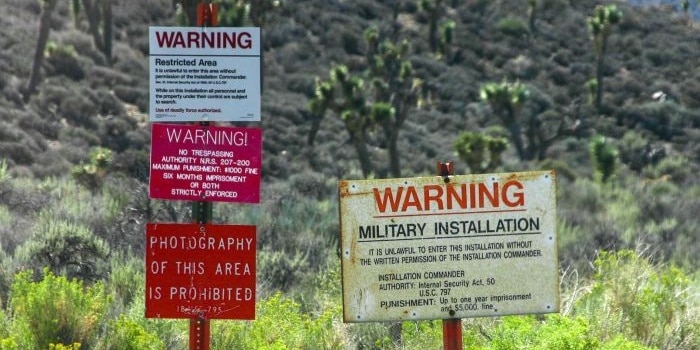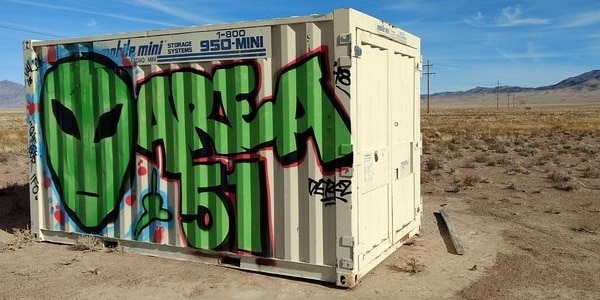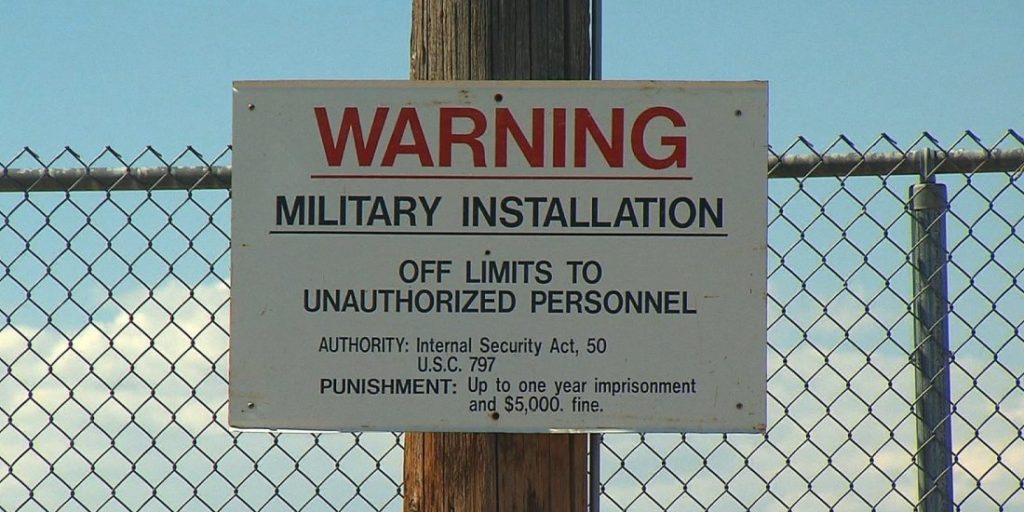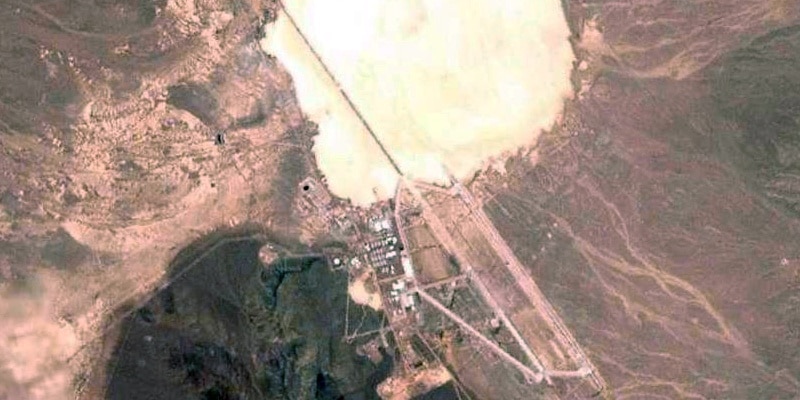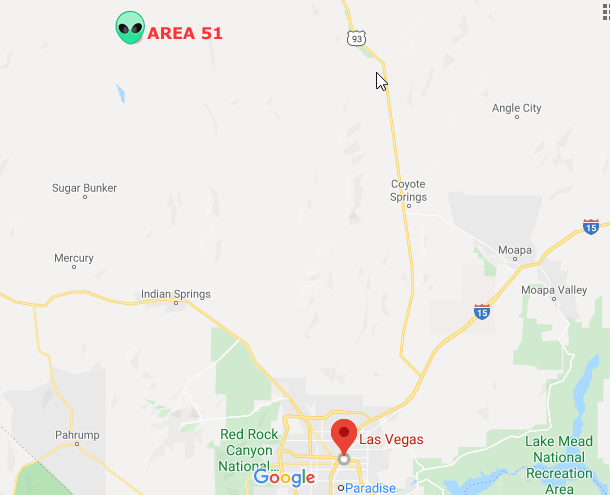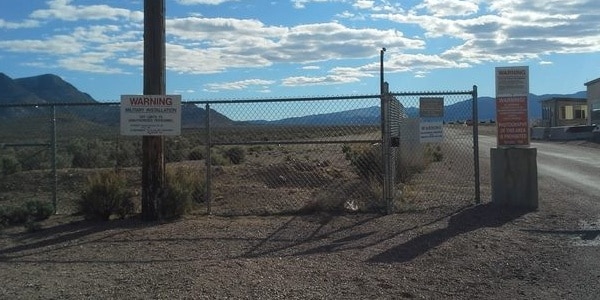






AREA 51, part of the Nellis Air Force Range and Nuclear Test
Site, is approximately 80-125 miles North and West of Las Vegas.
At Area 51 the U.S. government is test-flying highly secret
BLACK PROJECT aircraft for many years, several people think this
includes UFOs. They call one part of this military site Groom
Dry Lake area. It has been proven the Stealth and SR 71 projects
were built and tested at this famous Area 51. Many people refer
to this highly secret areas who work in and around this military
installation as "Dreamland" or "Skunkworks" or sometimes just
called "Groom Lake."
Map and Driving Directions fromVegas
From Las Vegas take I-15 north for 22 miles. At exit 64 take
US-93 north. After 85 miles, 12 miles past Alamo, you come to
the intersection with Hwy. 318 on the left. Directly across the
road from the intersection, to your right, you will see the
ruins of an old casino.
At the intersection turn left onto Hwy. 318, and after less
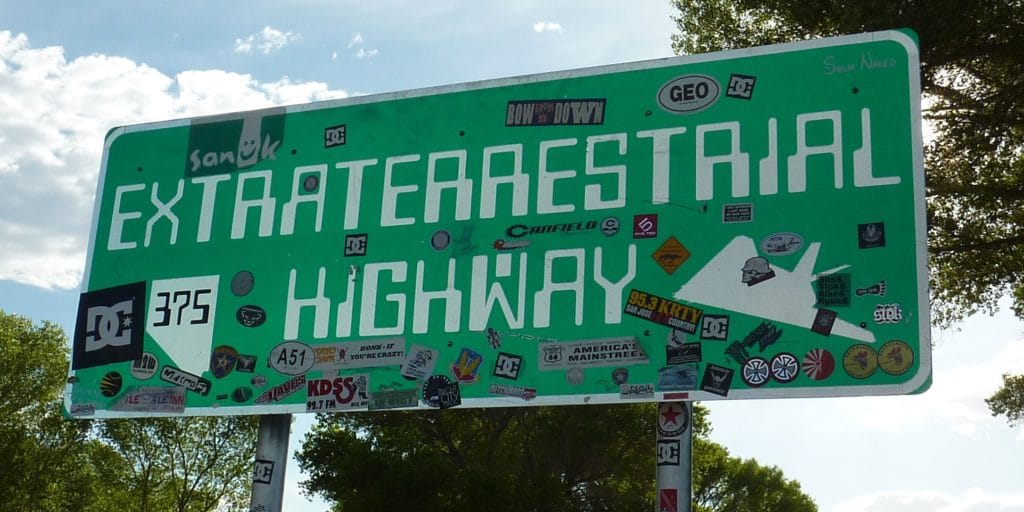
than a mile veer left again onto Hwy. 375. At that intersection
you will see the "Extraterrestrial Highway" sign under a group
of trees. Ironically, right next to the sign, in the shade of
the trees, is where some of the Area 51 workers park their cars
to take the white bus into Area 51.
From the beginning of Hwy. 375 it is about 15 miles over
Hancock Summit to the beginning of Groom Lake Road, 20 miles to
the Black Mailbox and 39 miles to Rachel.
The last gas in Las Vegas is at the Craig Rd. exit. There are
a few gas station on the way, in Alamo, Ash Springs, Rachel
(only regular unleaded) and Tonopah. However, some of the
stretches without gas are over 100 miles, and some of the gas
stations close at night. So you may want to keep an eye on your
gas.
Please note that most of Hwy. 375 is open range. There are no
fences, and cows frequently wander across the road. When you see
cows near the road slow down and be prepared to stop. Be
especially careful at night, when cows on the road are very hard
to see. Running into a cow will not only cause severe damage to
your vehicle, but you will also have to reimburse the rancher
for the cow.
"Private eyes in the sky," The Economist May 06,
2000 - Pike obtained the first one-metre images of Groom
Lake, better known as Area 51, the most secret military
complex in America.
"The secret's out," New Scientist 06 May 2000 --
Federation of American Scientists' believe that the
continuing speculation about the use of Area 51 illustrates
everything that is harmful and ridiculous about post-Cold
War government secrecy.
"Groom Lake Base Revealed In Sharp, New Satellite
Images," MICHAEL A. DORNHEIM Aviation Week & Space
Technology May 1, 2000 - Space Imaging made its 1-meter
photo available a few days later (see p. 61). It was taken
by the Ikonos satellite much more recently, on Apr. 2, two
months after it was requested by the Federation of American
Scientists in February.
"Area 51 photos show satellite imaging market heating
up," By MARTHA WAGGONER Associated Press April 25,
2000 -- "The competition between these companies is going to
make it difficult for the U.S. government to control the
market," said John Pike, the FAS Webmaster who ordered the
1-meter photos from Space Imaging of Thornton, Colo.
Snooping's Not Just for Spies Any More By WILLIAM J.
BROAD The New York Times April 23, 2000 - The
investigative use of space imagery has been strongly
encouraged by the Public Eye program of the Federation of
American Scientists. Its newest target is Area 51, and it
played a big role in the release of the new imagery.
Hacker disrupts service to Area 51 Web site
By MARTHA
WAGGONER, Associated Press April 21, 2000 - John Pike
of the Federation of American Scientists in Washington,
D.C., said he would guess the attack was an external denial
of service, like the one that happened to Yahoo! a few
months ago, and not from someone who gained access to the
server.
"Area 51 revealed in satellite views," By Alan Boyle
MSNBC 17 April 2000 -- John Pike, an expert on space
imagery at the Washington-based Federation of American
Scientists, said he was intrigued by the sheer size of the
Area 51 complex — especially when the pictures are compared
with overhead imagery produced in 1968 for the U.S.
Geological Survey. The federation posted side-by-side
comparisons on its Web site Monday afternoon.
"Uncle Sam, show us the UFOs," By Paul Bedard
U.S.News & World Report 1/24/00 -- The Federation of
American Scientists is daring the government to come clean
on one of the great mysteries of the 20th Century -– Area
51. In a test of wills, the nerdy group famous for its
efforts to reduce Big Brother's secrecy has hired
Denver-based Space Imaging to shoot satellite photos of the
highly protected Pentagon facility. John Pike of the FAS
doesn't expect to discover futuristic new aircraft for his
$1,000 effort.
The Significance of Area 51 Imagery
Apart from the simple voyeuristic thrill of gazing upon
secret things, which cannot be denied, there is a larger public
policy interest in overhead imagery of Area 51. The end of the
Cold War has occasioned only modest reforms in the grotesquely
hypertrophied security and classification system that insensibly
developed as the bodyguard of lies against the Soviet Union.
These security measures were not entirely without foundation, as
they were implemented to protect American weapons systems from
being copied or countered by the Soviet adversary.
But they were not without price, as over time the secret
government within the security enclave became increasingly
unaccountable to an increasingly distrustful public. With the
end of the Cold War, and in the absence of a worthy adversary
with the potential to copy or counter American weapons, it was
presumed that there would be an adjustment in the security and
classification system, towards greater transparency and public
accountability.
With some notable exceptions, however, the security enclave
remains remarkably unchanged from its Cold War configuration.
Indeed, in recent years a backlash has emerged, tending to
reverse even the modest gains in public accountability of the
1990s.
Humor is one of the few tools available for public efforts to
shift the boundaries of the security enclave. Declining to take
"secrets" seriously constitutes a fundamental epistemological
critique of a security and classification edifice that does far
more to protect bureaucratic interests than to protect the
national interest.
Highlighting the discrepancy between what the public knows,
and what the government will acknowledge, is a key instrument in
teasing out the absurdities of the security enclave. There is no
better opportunity for such mirth than Area 51. The US
Government has only recently acknowledged the "fact of the
existence" of this facility, despite ample publicity and
super-abundant speculation over the past decades.
The Good Book says "the guilty flee where none pursueth, but
the righteous are bold as a lion" [Proverbs 28:1]. Over time the
profound secrecy surrounding Area 51 has engendered an elaborate
edifice of popular culture, rehearsed most famously in the movie
"Independence Day." Sceptical observers may perhaps be forgiven
for suspecting that Area 51 is the repository for captured Alien
technology, since it would otherwise be difficult to imagine any
other secret so awful as to require the level of secrecy
surrounding this facility.
Reducing the excessive secrecy at Area 51, and throughout the
government generally, is an essential step towards restoring the
bonds between American society and the American government.
Corona Coverage of Groom Lake
An exhaustive search for imagery of Groom Lake at the
National Archives has revealed that all Corona imagery of
Groom Lake has been deleted from the original negatives as
well as the duplicate positives. This is apparently the case
for the duplicate positives set located at the USGS EROS
data at Sioux Falls, South Dakota. The deletions appear to
have taken place over thirty years ago, when the film was
originally placed into the Talent-Keyhole SCI Codeword
intelligence system.
The implications of this finding are interesting to say
the least. What this means is that an imagery analyst who
had a Top Secret security clearance and who had been
indoctrinated in the Talent-Keyhole system, still did not
have a sufficient clearance to see imagery of Groom Lake.
This level of compartmentation of intelligence information
borders on the surreal.
Lessons Learned - Public Imagery
Apart from the intrinsic interest in Area 51 itself, overhead
imagery of this facility provides important insights into the
dynamics of publicly available high-resolution satellite
imagery.
The new 1-meter IKONOS imagery provides substantial
interpretability gains relative to previously available 2-meter
imagery. This fact should be self-evident from the simple
physical reality that a single pixel in a 2-meter image is
revealed as four pixels in a 1-meter image. If it is not self
evident, contemplation of Area 51 at various resolutions should
prove enlightening.
If one picture is worth a thousand words, two pictures are
worth ten thousand words. The availability of new 1-meter
imagery does not render older 2-meter imagery obsolete, but
actually increases the importance of the older products.
Although each of the images of Area 51 is interesting, much of
what can be learned from these images is learned through
comparison of imagery acquired over time. While the importance
of negation imagery and change extraction is self-evident to the
classified national imagery exploitation community, the
classified community operates in an environment of profound
abundance relative to the public imagery community. Publicly
available imagery generally consists of global coverage with
declassified CORONA 2-meter imagery [with a 1972 cut-off date],
Russian 2-meter imagery from the 1980s and 1990s [though with
limited geographic coverage], and the new 1-meter imagery such
as is available from IKONOS. Over time the 1-meter archive will
grow, but absent the assistance of a time machine the new
commercial systems will unavoidably remain artifacts of the
Third Millennium. Public imagery exploitation campaigns will
continue to derive considerable benefit from Second Millennium
systems such as CORONA and the Russian SPIN-2.
Imagery is expensive, but imagery is cheap. The basic
cost of acquiring commercial satellite imagery has discouraged
potential users from investigating applications of this product,
but imagery acquisition costs are only a small fraction of the
total cost of an imagery campaign. Imagery from the new
commercial high-resolution satellite systems typically costs
thousands of dollars for each scene. For IKONOS, the costs can
range from about $1,000 for a small scene covering territory
inside the United States to over $5,000 for a large scene of
territory outside the United States. The intelligence cycle is
conventionally partitioned into tasking, collection, processing
and dissemination -- figuring out what you want, getting it,
figuring out what you have gotten, and telling others what you
have. In round numbers, it may be conveniently estimated that
the cost of each of these four elements of the intelligence
cycle are roughly the same. Although commercial satellite
imagery can cost thousands of dollars, in the real world this
may represent only a quarter of the total cost of an imagery
campaign. The other three quarters of the cost is represented in
staff time and other expenses associated with tasking,
processing and dissemination. Although commentators have largely
focused on interpretation as the greatest challenge facing the
public imagery community, in the real world the other components
of the intelligence cycle are equally if not more challenging.
In any event, they are certainly extremely time consuming.
Previously expressed concerns about the potential for commercial
high resolution imagery to compromise the security of American
military operations [such as the "left hook / Hail Mary"
maneuver of American forces in the prelude to Desert Storm] have
not taken into account the time and motion investment that would
be required to implement such an imagery campaign. In the real
world, such a campaign would be extraordinarily challenging, and
expensive, and it is not immediately evident that either the
news media or non-governmental organizations would be
pre-disposed to mount the requisite effort [totally apart from
whatever shutter control might be imposed]. Indeed, now that
some practical time and motion data is available on the
collection management of the commercial 1-meter product, it
would be interesting to undertake a retrospective "what could we
know and when could we know it" analysis of the Desert Storm
exemplar. This could provide greater fidelity on the
cost/benefit tradespace that would confront a public imagery
campaign focused on US military operations, and the risks [if
any] that could be mitigated by US government shutter control
policies.
The visible hand of the imagery marketplace is moving
pixel-pushers towards greater customer satisfaction. In
early February 2000 it was publicly reported that FAS had tasked
SpaceImaging to provide imagery of Area 51. It would appear that
the decision of Aerial Images to provide Russian imagery of Area
51 through the TerraServer implementation was driven in some
measure by an awareness of the probable public interest in such
imagery, and the possibility of regaining mind-share from
SpaceImaging. It cannot escape notice that SpaceImaging provided
the long-awaited IKONOS imagery a few hours after the debut of
Area 51 on TerraServer [some two weeks after the image was
actually acquired]. Such market competition may [or may not]
stress the US government's shutter control policy, which is
predicated on retaining control of commercially available high
resolution imagery through pre-emption of the marketplace by
companies subject to US government licensing restrictions.
Information age industries are generally characterized by "first
past the post, winner take all" market dynamics. Information
industry innovators, particularly those which achieve early
market dominance, are effectively able to pre-empt the market
and preclude other later entrants from gaining significant
market share. Microsoft is the exemplar of this dynamic, and the
enthusiasm with which the various dot.com internet companies
burn money is predicated on exploiting this dynamic of
transforming mind-share into market share. Four of the five
announced entrants into the high resolution commercial imagery
market are licensed by the US Government, and subject to US
Government shutter control restrictions. The fifth announced
entrant is a Russian company, and the status of this Russian
project remains uncertain. Apart from the commercial interests
of the American companies selling Russian imagery [the Aerial
Images / TerraServer partnership], it is interesting to
speculate on Russian interests in releasing Area 51 imagery. In
March 2000 SpaceImaging released "before and after" imagery of
the devastation caused by the Russian military assault on Grozny,
the capital of Chechnya. While it is probably futile to
speculate on the precise process that led to the public release
of the Russian imagery of Area 51, this exploit may serve as a
useful exemplar of a "retaliatory release" of imagery.
Commercial 1-meter imagery appears stabilizing rather than
de-stabilizing, far more applicable to peace-time verification
than to war-time targeting. During the Cold War the
transparency created by satellite imagery was generally regarded
as contributing to stability. One of the primary concerns raised
by the advent of commercial near-realtime imagery is the
possibility that it could be used for wartime targeting and
damage assessment, which could be regarded as de-stabilizing.
The potential for such warfighting applications depends first on
how near to realtime the "near-realtime" product actually is,
and second [and most importantly] on the dependability and
predictability of the product. In the real world, an imagery
intelligence system with a latency [the interval between tasking
and delivery] of a few days may or may not be useful for
warfighting. In principle, the IKONOS system can provide
collection managers with such "near"-realtime imagery, as
demonstrated by the next-day collection of imagery of a 28 March
2000 tornado in Texas. In practice, the delay of over two months
in providing an image of Area 51 strongly suggests that
commercial vendors such as SpaceImaging would not be regarded as
"usually reliable source" for warfighting intelligence.
Apart from the intrinsic interest in Area 51, the Public Eye
initiative of the Federation of American Scientists tasked
IKONOS imagery of this facility as an experiment to validate the
potential applicability of commercial high resolution imagery to
warfighting applications. The explicit restrictions on
commercial imagery are well-known -- no high resolution imagery
of Israel, and shutter control when imposed by the US government
in connection with military operations. The possibility of less
formal or explicit restrictions on the availability of imagery
is less well understood, though perhaps subject to experimental
verification. The possibility could not be excluded that
additional restriction on imagery availability, beyond the
formal legal requirements of the government license, could
result from either explicit corporate policy or informal
influence from various sources. If in fact such informal shutter
controls were to be imposed, Area 51 would surely be a leading
candidate for such restrictions. The operational security
managers of the Groom Lake facility are surely the world's most
experienced, and presumably the most competent, practitioners of
the art of hiding things from reconnaissance satellites. While
there was no reason to anticipate that commercial imagery of
this facility would reveal anything of particular sensitivity,
Area 51 itself is nonetheless perhaps the most "sensitive" US
Government facility, and thus an excellent candidate for an
experimental exploration of informal shutter control. Indeed,
several years ago, in response to the announced intention of FAS
to eventually acquire imagery of Area 51, it was publicly
reported that SpaceImaging intended as a matter of corporate
policy to sell no imagery of any US military facility, to
include Area 51. It would not be particularly productive to
speculate too deeply on the sources of the profound delay in the
availability of the IKONOS imagery of Area 51. This delay will
not escape the notice of military intelligence collection
managers around the world. The tasking responsiveness of the
IKONOS system remains obscure, if not opaque, and such
commercial systems would not appear a promising source for
reliable near-realtime targeting intelligence.
Protected by almost a thousand square miles of restricted
airspace and surrounded by the Nevada Test Site, lies a secret
airbase where the government has tested advanced technology
aircraft for the past forty years. Known to most people as Area
51, the facility also has been referred to as Groom Lake, The
Ranch, Watertown strip, and within the government the
Directorate for Development Plans Area. Area 51 is an official
government secret, and yet widely known in the popular culture.
The enormous steps the government has taken to keep the fact of
the existence of this secret test facility out of the public
domain is matched only by the public's interest in the site, and
the extensive amount of information that is available in the
open press. Much of the interest in Area 51 comes from the UFO
subculture who are at least suspicious if not convinced that
crashed alien spacecraft as well as the bodies of aliens are
stored at Area 51.
In a sense, the government's security problem is a
self-inflicted. Excessive government secrecy during the Cold
War, domestic spying and other scandals by the CIA, the belated
declassification of the explanation of UFO sightings later
explained in the Roswell report, secret radiation experiments on
unwitting citizens by the Department of Energy (then Atomic
Energy Commission) have contributed to an intense suspicion
among some that the government is "hiding something." This
perception is not unjustified given the extensive secrecy
surrounding the facility. Of course the government is hiding
something -- a secret flight test facility for advanced
technology aircraft.
Groom lake started out as an Army Air Corps Gunnery Range
during World War II. In the mid-1950's Lockheed was searching
for a remote base to test its new U-2 spy plane. Although the
runway on the remote dry lake bed was unusable, the location was
deemed to be ideal due to its remoteness and by the summer of
1955 construction of a 5,000 foot runway began, with two hangars
and some temporary living quarters. Later surplus Navy military
quarters were dismantled, shipped to Groom, and reassembled. The
first U-2 arrived on a C-124 later in 1955. The U-2 was
reassembled, checked out, and on August 4, 1955 Tony Levier made
the first flight test.
With the arrival of the A-12 program the runway was
lengthened to 8,500 feet, fuel storage tanks capable of holding
up to 1,320,000 gallon of JP-7 were added, as well as three
surplus navy hangars and 100 surplus Navy housing buildings.
Eight hangars at the south end of the base were build to house
the A-12 spy planes.
By the 1980's a weapons storage area south of the main base
was added, with five earth-covered igloo's, presumably to
support weapons testing for the F-117 program, and possibly the
advanced cruise missile program.
Until recently, the facility was supported by one 12,400 long
100 foot wide hard surface runway, which extends onto the dry
lake bed North, giving it a total length of 25,300 feet or 4.8
miles. Sometime in the early 1990's this runway was deactivated,
and replaced by a new 11,960 foot long 140 foot wide runway.
Several indicators suggest that Groom Lakes' flight test
activity did not end with the F-117 Stealth Fighter. First,
construction of a new runway which must have started sometime
after the F-117 program had been made public. Second the
numerous reports by aviation enthusiasts and others of unusual
aircraft noise and lights at night in the years since the F-117
became public. Third, the 1995 action by the Department of
Interior to withdraw 3,972 acres of Bureau of Land Management
land, from public access, creating a security buffer zone to
prevent public viewing of military activities at Groom Lake.